

BOTANICAL BIOGRAPHY OF THE NETHERLANDS
Plants tell the life story of the Netherlands
VOC and WIC era (17th and 18th centuries) and the
colonial period (19th century and the first half of the 20th century).
---------VISION---------
#1. Introduction
Plants tell the life story of the Netherlands
Plants have shaped the Netherlands. They formed the basis for the trade in food crops, medicines, dyes, and spices, thereby making a significant contribution to our prosperity, culture, and landscape.
Behind every plant lies a story: about people, the global exchange of knowledge, curiosity, trade, and the history of the VOC and WIC periods and the subsequent colonial era.
However, the awareness of this influence has largely disappeared.
Stories, drawings, and botanical collections are scattered across archives, libraries, and museums and are rarely told in their interconnectedness.
With the Botanical Biography of the Netherlands, we bring these stories together again.
Not as a traditional history, but as a living story in which plants play the leading role and it becomes visible how they have shaped our history, society, culture, landscape, and identity.
#2. Mission and Vision
Mission
The Botanical Biography of the Netherlands aims to re-establish awareness of the fundamental influence of plants on our history, society, economy, culture, landscape, and identity.
At the same time, we investigate the role of local plant knowledge in the discovery, use, imagination, and dissemination of plants. In doing so, indigenous communities, enslaved people, and other local knowledge bearers are given a place in the story once again.
We view botanical heritage as shared cultural heritage. Therefore, we connect Dutch collections with the countries where they originated and build an international network in which researchers, artists, heritage institutions, and local communities collaborate to add new knowledge, stories, and contemporary meaning to this heritage.
Vision The Botanical Biography invites us to look anew at our history and shared cultural society from the perspective of plants.
Botanical heritage is not only preserved or displayed, but also re-examined, interpreted, and made tangible.
Historical sources are connected with contemporary art, local communities, biodiversity, and current societal issues.
In this way, a polyphonic history emerges in which plants play the leading role.
#3. Explore - Connect - Enrich
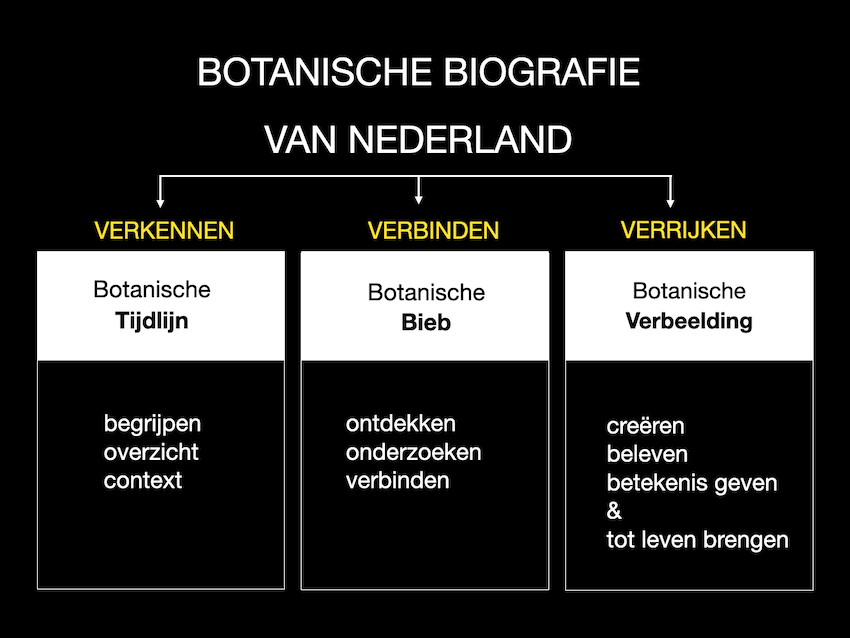
The Botanical Biography of the Netherlands consists of three interconnected parts: Exploring, Connecting, and Enriching. Together, they make Dutch botanical heritage accessible, link scattered knowledge, and give the past new meaning for today's society.
- EXPLORE -
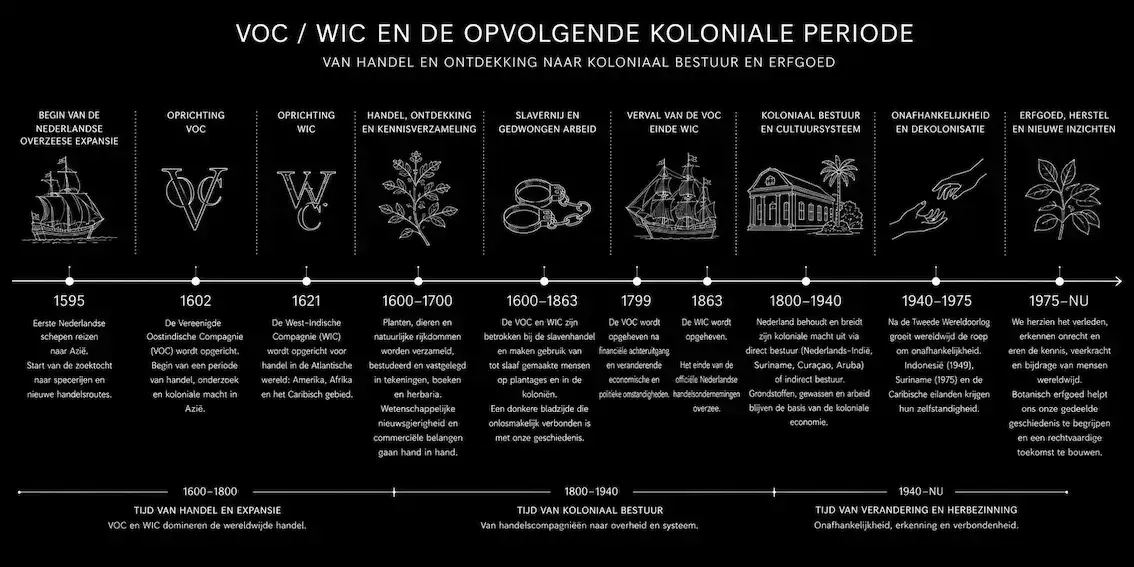
The Timeline forms the foundation of the Botanical Biography. It brings together hundreds of years of botanical history in a single overview and makes immediately visible how plants, science, art, trade, colonialism, slavery, indentured labor, biodiversity, and societal developments are intertwined. Whereas knowledge is currently often scattered across books, archives, and museums, the timeline offers a clear overview in which botanical masterpieces and historical events become visible in their interconnectedness.
- CONNECT -
The Botanical Library digitally brings together scattered botanical collections, historical books, plant illustrations, archives, stories, and research in one central location. Visitors can browse the collection, discover connections between various sources, and delve into the stories behind plants, artists, researchers, and local knowledge holders. This creates a living, growing knowledge environment in which heritage is no longer fragmented but interconnected.
- ENRICH -
De Botanische Verbeelding gives botanical heritage new meaning by connecting participation, craftsmanship, art, and immersive experience. Residents and local artists create a contemporary reimagining of historical botanical heritage together. These handmade artworks form the basis for exhibitions, book sculptures, and multimedia projections, allowing visitors not only to look at the past but also to experience, discuss, and become part of it themselves.
#4. Why a Botanical Biography?
The Netherlands has a rich history of cities, country estates, art, science, and trade. Less visible is the fundamental role plants have played in this. They provided food, medicines, dyes, spices, and cash crops, and formed the basis for international trade networks, scientific research, and botanical collections.
From the sixteenth century onwards, a great interest arose in plants from all parts of the world. European researchers, botanists, artists, collectors, traders, and explorers went in search of species with medicinal, economic, ornamental, or scientific value. Plants were collected, studied, described, dried, drawn, painted, traded, and cultivated. This centuries-long quest led to impressive botanical collections containing thousands of plants, which today form an important part of our cultural heritage.
Behind these collections lie stories of curiosity, collaboration, and knowledge exchange, but also of colonialism, slavery, indentured labor, and unequal power relations.
Much botanical heritage has been preserved in museums, libraries, archives, herbaria, and botanical gardens. However, the coherence between these collections has largely disappeared from view.
As a result, the awareness has also faded that plants were not only the subject of scientific research, but also helped shape the history of the Netherlands.
The Botanical Biography of the Netherlands brings these scattered stories back together. By connecting botanical heritage, historical research, contemporary art, and participation, a new way of looking at our history emerges: from different perspectives and with special attention to local plant knowledge that has long remained underexposed.
In this way, a living biography is created in which plants play the leading role and in which past and present are connected.
#5. What is a Botanical Biography?
A Botanical Biography describes and visualizes the history of a province as if it were a living being, with plants as the protagonist. Every province possesses its own botanical life story. By connecting botanical heritage, historical research, landscapes, and contemporary art, a new way of looking at the history of a province emerges.
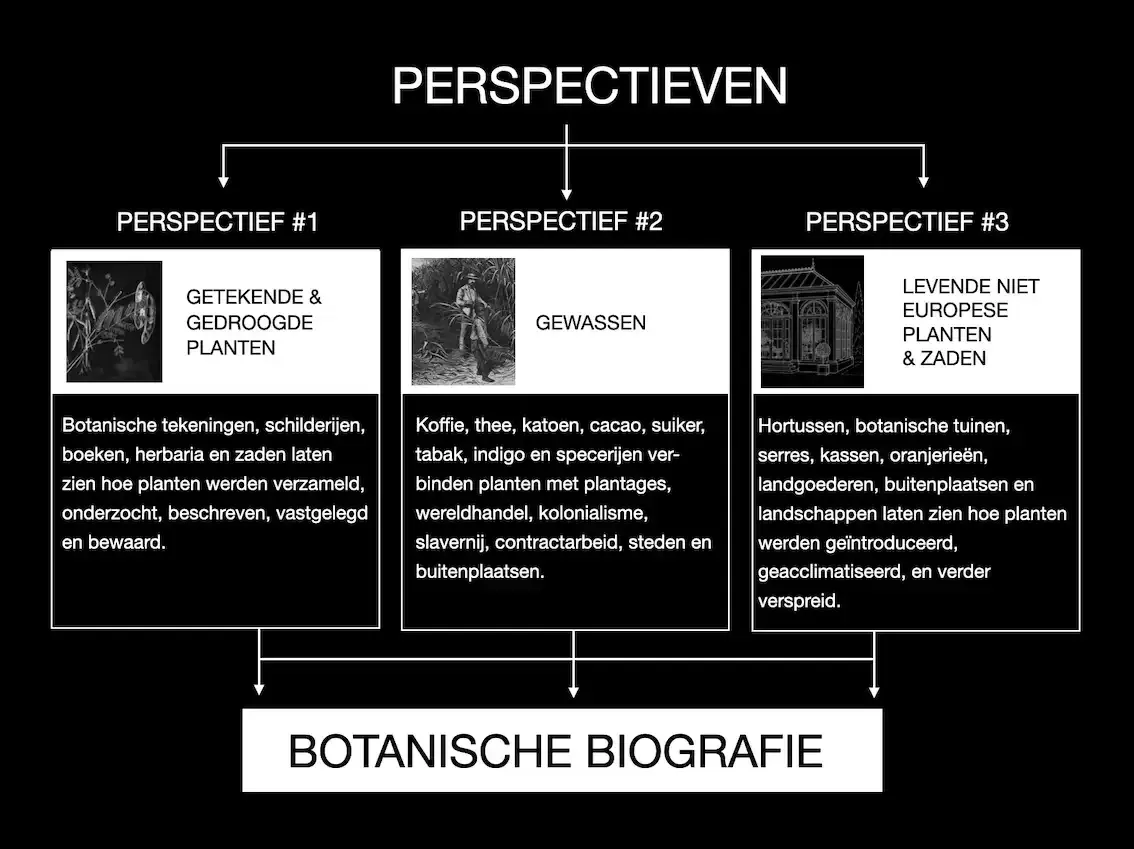
The Botanical Biography tells the life story of a province from three interconnected perspectives. Together, they form a single botanical life story.
#6. Perspectives
#7. Research question
In doing so, we investigate the question: what role did local plant knowledge of indigenous communities, enslaved people, and other local knowledge bearers play in the way plants were discovered, used, imagined, and disseminated during the VOC/WIC period?
and the subsequent colonial period?
# Perspective 1
Drawn and dried plants
What role did local knowledge of plants play in the discovery, description, and documentation of plants?
# Perspective 2
Crops
What role did local plant knowledge play in the economic application and global distribution of crops?
# Perspective 3
Living plants
What role did local plant knowledge play in the introduction, acclimatization, and spread of non-European plants in the Netherlands?
#8. Thema’s
The three perspectives determine what is investigated. The research question determines the viewpoint regarding the heritage. Five interconnected research themes run through all three perspectives.
# Topic 1
Botanical artists and researchers
Who documented plants, gathered knowledge, and contributed to the development of botanical science, art, and collections?
This involves examining both well-known and lesser-known artists, botanists, collectors, amateurs, illustrators, and assistants. The focus is not only on the final result, but also on the collaborations and knowledge networks that preceded it.
# Topic 2
Local plant knowledge
What role did indigenous communities, enslaved people, and other local knowledge bearers play in the discovery, use, description, documentation, and dissemination of plants?
Many European botanical works could only have come into existence thanks to local language knowledge, medicinal knowledge, agricultural practices, plant names, and knowledge of habitats and uses. These contributions were often not mentioned, or only mentioned to a limited extent.
# Topic 3
Trade history
How have trade, colonialism, slavery, and indentured labor influenced the global spread of plants and crops?
Plants are linked to trade routes, plantations, ports, families, country estates, cities, and economic systems. Attention is paid to both the yields in the Netherlands and the circumstances under which this wealth was produced.
# Topic 4
Biodiversity
What do historical collections tell us about the distribution, change, and protection of plant species over time?
Herbaria, seeds, drawings, and botanical books can contain information about vanished habitats, extinct species, changing ecosystems, and diseases. At the same time, former colonial experimental gardens transformed into institutions that today play an important role in research and nature conservation.
# Topic 5
Emancipation
Which stories of women, local researchers, illustrators, and other underrepresented creators deserve a place in history once again?
The Botanical Biography investigates how people developed as artists, researchers, teachers, or bearers of knowledge within restrictive societal and colonial structures. In doing so, not only do forgotten names become visible, but also processes of independence, recognition, and emancipation.
#9. Layered Botanical Biography Method
The Botanical Biography is more than a historical study or an art project. It is an artistic research and participation method that connects botanical heritage, history, science, art, and encounter.
Historical sources form the starting point, but not the endpoint. By combining archival research with contemporary art and participation, space is created for new perspectives and stories that have long remained underexposed.
The method has been developed not only to make botanical heritage visible, but also to give it new meaning.
Residents of each province are invited to participate in the research, create, and share stories. In this way, a living Botanical Biography is created that continues to grow through new insights, encounters, and stories.
The Botanical Biography Method consists of a number of successive layers. Each layer adds a new dimension. Together, they form an artistic research process in which past, present, and various perspectives are interconnected.
The method begins with a historical botanical book and ends with that same book, which is brought back to life through research, art, participation, and immersive technology. In doing so, the method completes a circle and its origins become visible once again.
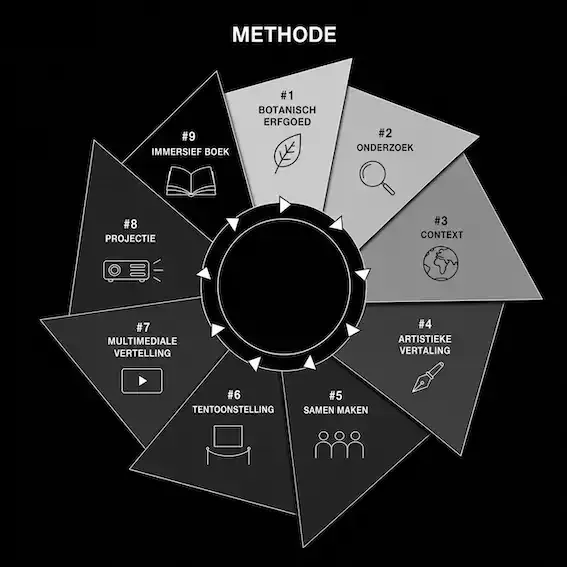
Click on the tabs for more information per layer >
Layer #1
Layer #2
Layer #3
Level 1 – Starting point: Botanical heritage
Every Botanical Biography begins with a historical botanical work connected to the chosen province. This can be a book, herbarium, collection, series of drawings, or another botanical heritage collection.
This botanical heritage forms the starting point for the Botanical Biography and inspires new research, encounters, and contemporary imagination.
Goal
Making the original botanical heritage visible, accessible, and experienceable once again.
Layer 2 – Research
Starting from the historical botanical work, an in-depth investigation begins into the plants, the people, the places, and the events that are connected to one another.
The research forms the substantive basis of the Botanical Biography and yields new insights that broaden and enrich existing historical narratives.
Goal
Developing new knowledge and broadening existing narratives.
Layer 3 – Context
Every botanical work is placed in the historical, geographical, and social context in which it originated.
By connecting plants to their country of origin, the time in which they were documented, and the people involved, a more complete picture emerges of the history behind the botanical heritage.
Goal
Placing botanical heritage in the historical, geographical, and social context in which it originated.
Layer #4
Layer #5
Layer #6
Layer 4 – Artistic translation
The historical botanical heritage and research results are translated into a contemporary artistic concept. The focus is not on reproducing the past, but on creating a new imagination that does justice to both the beauty and the historical context.
The artistic translation forms the bridge between research and participation and makes the botanical heritage tangible once again for a broad audience.
Goal
Translating the historical botanical heritage into a contemporary artistic imagination.
Level 5 – Making together
Under the guidance of a local artist, residents work together on a contemporary interpretation of the historical botanical heritage. The original images are re-imagined using contemporary techniques, such as pen drawing, embroidery, papercutting, or other artisanal techniques.
Preferably, people with diverse cultural backgrounds participate, including those with a connection to the country where the original botanical work originated. This creates space for new encounters, conversations, and perspectives. Goal
Creating a contemporary visualization of the botanical heritage together with residents.
Level 6 – Exhibition
The contemporary imagination is exhibited at a location that is thematically connected to the botanical narrative, such as a library, museum, botanical garden, country house, estate, or other heritage site.
The exhibition invites visitors to discover the botanical heritage from new perspectives and forms the starting point for the next layer of the Botanical Biography.
Goal
Bringing together botanical heritage and contemporary imagination in a meaningful encounter with the public.
Layer #7
Layer #8
Layer #9
Level 7 – Multimedia storytelling
The insights and results from the preceding layers are brought together in a single multimedia narrative. Historical botanical heritage, research, context, contemporary imagination, participation, and the exhibition together form one coherent story.
The multimedia narration brings the Botanical Biography to life and forms the bridge to the immersive experience in the subsequent layers.
Goal
Bringing together the preceding layers into a single multimedia narrative that brings the Botanical Biography to life.
Layer 8 – Projection
The multimedia narrative is projected onto the contemporary artworks. Through image, light, and movement, the historical story comes to life, creating a new artistic layer in which botanical heritage is experienced in a contemporary way.
The projection enhances the experience of the exhibition and forms the basis for the film of the Immersive Book.
Goal
Bringing the historical story to life by connecting the multimedia narrative with the contemporary artworks and thereby creating an immersive experience.
Level 9 – The Immersive Book
The results of the preceding layers come together in the Immersive Book. Botanical heritage, research, context, contemporary imagination, participation, exhibition, multimedia narration, and projection combine to form a single immersive experience.
Through projection mapping, the multimedia narrative is projected onto a monumental sculpture in the shape of a large open book. In this way, the historical botanical book with which the Botanical Biography began comes to life again. Goal
Bringing the historical botanical book from Layer 1 back to life by bringing together the results of all previous layers into a single sculpture that resembles a large open book.
#10. Treaty of Faro
The Botanical Biography of the Netherlands aligns closely with the principles of the Faro Convention (Council of Europe, 2005). This convention focuses not only on the preservation of heritage, but above all on the meaning that people attribute to it. Heritage gains value because people use the heritage:
- Explore > Timeline
- Connect > Botanical Biology
- Enrich > Contemporary imagination
The Botanical Biography thus offers a concrete course of action for museums and heritage institutions to put the principles of the Faro Convention into practice:
#11. International perspective: shared botanical heritage
The Botanical Biography of the Netherlands tells a Dutch story, but the botanical heritage from which this story originates is simultaneously international heritage. Many of the plants, drawings, and botanical descriptions were created in collaboration with local experts, artists, collectors, and researchers in countries such as India, Indonesia, Suriname, Sri Lanka, and South Africa.
For a long time, these works have been described and preserved primarily from a European perspective. As a result, many local voices, knowledge, and personal stories have faded into the background or have not been recorded at all. At the same time, these books and collections also belong to the cultural memory of the countries where the plants grew and where the knowledge originated.
The Botanical Biography therefore aims not only to examine what these collections mean for the Netherlands, but also the significance they hold today for the communities where this heritage originated.
- What stories do researchers, artists, and residents want to tell there themselves?
What knowledge has been preserved orally?
Which historical events are important from their perspective?
What new meanings can be added to these collections?
Therefore, the Botanical Biography explicitly chooses to collaborate with international partners. Not to tell stories on behalf of others, but to create space for multiple perspectives side by side. Historians, botanists, artists, heritage institutions, and residents are invited to add their own knowledge, memories, and interpretations. In this way, a richer and more complete picture of the history of plants, people, and knowledge exchange emerges.
#12. Participative Approach
Participation forms an essential part of the Botanical Biography Method.
Under the guidance of a local artist, residents of a province collaborate on a contemporary interpretation of historical botanical heritage. The joint creation of a single artwork brings together different styles, experiences, and perspectives.
In conversation with each other
Drawing, looking, and creating together proves to be an accessible way to get people talking. Previous projects show that conversations often arise spontaneously when participants share an interest, such as: plants history creating.
A making session begins with an inspiring introduction of approximately half an hour about the historical background of the chosen botanical heritage. This part is important: participants are introduced to the botanical heritage of the province in which they live and learn to better understand this heritage and place it in context.
At the same time, the introduction is not a dry lecture, but rather a substantive starting point: a stimulating first introduction that arouses curiosity. There is room for questions, additions, personal stories, experiences, and suggestions. In this way, interaction is created, and the story becomes richer with each passage.
Inclusive
When composing the participant groups, the aim is to achieve inclusivity in terms of diversity in age, experience, and cultural background. Everyone can sign up for a drawing day; all cultural backgrounds and all levels of drawing and craft experience are welcome. In addition, we actively seek participants with a personal or cultural connection to the country where the historical botanical work originated, so that these perspectives are also given a place in the joint process.
The ambition is for participants to gradually develop into active ambassadors of the biography. Following the 'teach the teacher' principle, they learn to guide new participants, pass on knowledge, and independently organize drawing days.
In this way, independent working groups gradually emerge that together form a sustainable Botanical Heritage Community.
By jointly portraying heritage in a new way,
becomes history
intensely shared, experienced, and remembered.
#13. Design principles
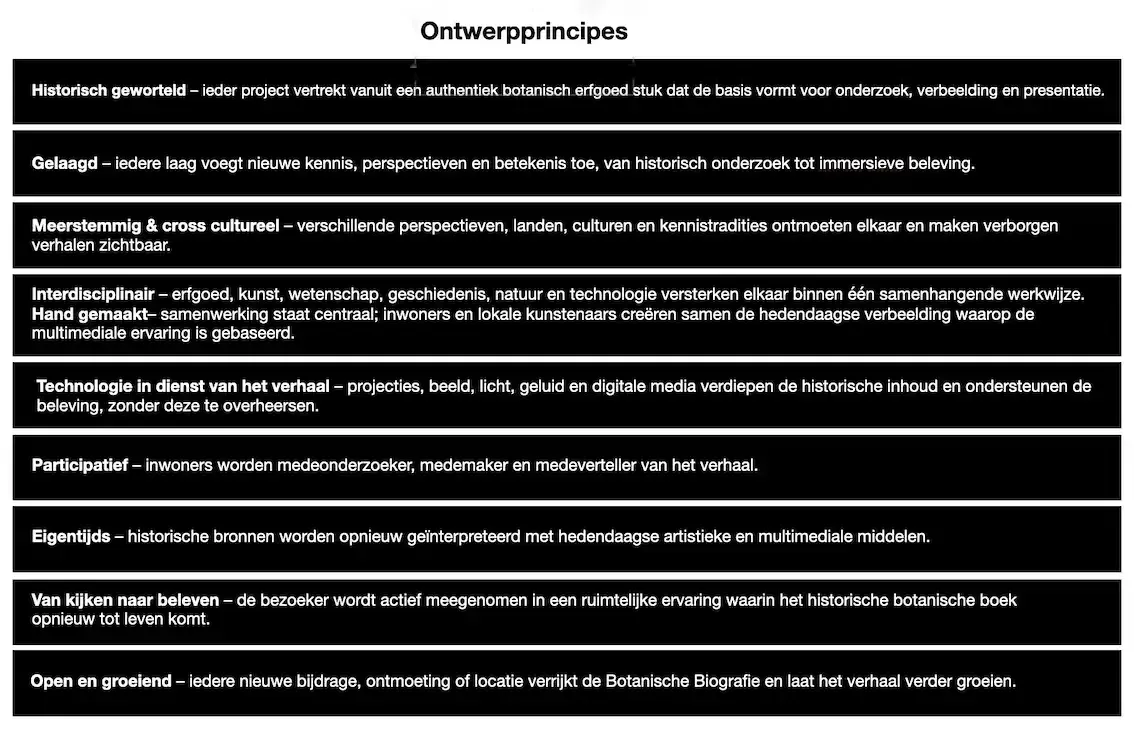
Together with a partner, De Botanische Biografie is developing its own form of authentic immersive storytelling in which historical botanical heritage, artistic research, handmade elements, and digital technology reinforce each other.
The immersive experience begins not with the technique, but with the historical botanical book, in-depth research, and a contemporary artistic translation created by hand. Local artists and residents together form the human and tangible foundation of the project.
By combining project mapping, high-resolution projections, spatial audio, and scenographic design, a multimedia narrative is created in which the historical botanical book comes to life again. The technology supports the story and reinforces the significance of the botanical heritage, without taking the lead.
In doing so, The Botanical Biography opts not for a spectacular show or a digital attraction, but for a carefully constructed minimalist experience in which historical authenticity and artistic imagination are in balance.
Visitors are taken on an informative journey in which images, light, and sound bring the historical botanical book and the stories behind it back to life. This creates an immersive experience that not only informs and amazes, but also invites us to look anew at our history and shared cultural society from the perspective of plants.
Precisely in a time when artificial intelligence (AI) is generating more and more images, the need for authenticity, craftsmanship, and tangibility is growing. The Botanical Biography therefore connects handmade and technology in one cohesive experience, in which the historical botanical book comes to life anew.
#14. Precedent research
The Botanical Biography did not originate from a single idea, but from research into existing art, heritage, and immersive projects that succeed in connecting a broad audience with history in a meaningful way.
This precedent study examined the underlying design principles. Which choices foster engagement? How do research, art, and participation reinforce each other? And how can new media be utilized without losing the authenticity of the story?
The insights from this research form the basis for the Botanical Biography Method. Not by copying existing projects, but by analyzing proven success factors, combining them, and further developing them into its own artistic research and participation method.
#1. Threads of our Slavery Past (Villa Maecenatis Foundation / Ricardo Buitenzorg)
The main source of inspiration for the Botanical Biography is the project Threads of Our Slavery Past by the Villa Maecenatis Foundation. This project shows how historical heritage regains meaning by combining historical research, art, participation, and regional connectedness.
In this participatory project, the process of creating together is at least as important as the end result: a monumental tapestry. The design is created by a local artist with a cultural background or a demonstrable connection to the country central to the theme, such as Suriname. Behind every image lies meticulous historical research, which is made accessible via the website and publications. The relationship between the research, the historical context, the artistic choices, and the final design of the tapestry is clearly illustrated.
Design principles translated into the Botanical Biography:
- monumental artworks that do not leave visitors unmoved;
- a provincial approach, allowing people to recognize themselves in their own environment and history;
- collaboration with a local artist who has a substantive, cultural, or personal connection to the country or theme at the center;
- craftsmanship as the basis for authenticity;
- co-creation with residents, resulting in new encounters and the sharing of stories;
- a clear connection between historical research, artistic choices, and the final artwork;
- in-depth study via website, publications, and educational material;
- An open working method: everyone can participate.
Whereas Threads of Our Slavery Past centers on a single historical theme, the Botanical Biography uses plants as a starting point to tell a broader societal and historical story. From a single piece of botanical heritage, connections emerge with botanical artists and researchers, local plant knowledge, biodiversity, trade history, colonialism, slavery, indentured labor, science, culture, landscape, and emancipation, among others. The plant serves as the common thread connecting all these perspectives.
The Botanical Biography builds upon the model of historical research, participation, and monumental art, but adds a number of its own design principles that further develop the method.
Additional design principles of the Botanical Biography
- Digitization as a second life: upon completion, the handmade artworks are digitized and form the basis for multimedia narratives, project mapping, immersive installations, and the Botanical Library. In this way, a single physical artwork grows into a sustainable digital heritage archive that can be used for education, exhibitions, and online audience outreach.
- Visibility of participants: participants are credited by name, and the collaborative creative process is documented photographically and audiovisually. As a result, not only the final result is preserved, but also the story of the people who created it together.
- Dedicated drawing days: anyone can sign up for a drawing day; all levels of drawing and craft experience are welcome. Participants then work together on a single artwork for a full day (10:00–16:00). There is no walk-in. This shared concentration, dedication, and continuity ensure quality, depth, and mutual connection.
- Provincial distinctiveness: each province is assigned its own artistic technique, style, and form of presentation, befitting the botanical heritage, the story, and the identity of the province.
- Multiple forms of presentation: each project results not only in a physical artwork, but also in multimedia applications, online stories, and immersive presentations. As a result, the botanical heritage reaches a broader and more diverse audience, and the story continues to evolve.
#2. Studio McGuire
Studio McGuire inspires through the way craftsmanship and digital technology reinforce each other. Projects such as The Icebook and The Paper Architect demonstrate that an immersive experience is most convincing when it stems from a physical, handmade object.
For the Botanical Biography, this confirms the premise that technology is never the starting point. First, historical research, artistic craftsmanship, and a tangible artwork emerge; then, digital technology is deployed to deepen the story and take visitors on an authentic, immersive experience.
#3. Dogville – Lars von Trier
Dogville demonstrates how minimal scenography can evoke maximum imagination. With only white lines on a black floor, a complete world emerges in which the story becomes more important than a realistic reconstruction.
This approach inspires the spatial design of the Botanical Biography, in which simplicity, light, and suggestion focus attention entirely on the historical narrative.
#4. William Kentridge
The work of William Kentridge is fascinating and shows how art, movement, theater, and projection reinforce each other in a natural way. Precisely because the art remains visible, a powerful and human form of authentic immersive storytelling emerges.
This approach aligns with the design philosophy of the Botanic Biography, in which the making process remains part of the experience and technology supports the craft.
URLAND – Before the Story Starts
The performance Before the Story Starts inspires through the innovative way in which story structure, different perspectives, and digital voice techniques come together. The performance shows how contemporary technology can contribute to a layered narrative without losing sight of the human dimension.
PAINTING WITH LIGHT
The projection installation by Painting with Light at Theater aan het Vrijthof in Maastricht shows how subtle movements in light and image can enhance a story. The projections bring the image to life without distracting the viewer, creating a calm, layered, and immersive viewing experience.
For the Botanical Biography, this serves as a source of inspiration for the development of its own form of authentic immersive storytelling, in which the historical botanical book, the contemporary artworks, and the stories come together in a single spatial experience.
Studio Immersief / Zuiderzeemuseum
Studio Immersief developed the XR experience Schokland: No Way Back for the Zuiderzeemuseum. In this combination of theater, physical sets, and virtual reality, visitors are transported to the vanished island of Schokland and experience the consequences of the forced evacuation in 1859 up close. Instead of merely conveying information, the experience places visitors literally in the middle of the story.
The strength of this project lies in the way historical content, spatial design, and immersive technology reinforce each other. Visitors not only develop more knowledge about the past but also experience its emotional impact. In doing so, the project demonstrates that immersive media can be a powerful tool for making heritage accessible, relatable, and relevant to a broad audience.
Panorama Mesdag
Panorama Mesdag serves as a source of inspiration for the way historical information is visually organized and presented. For the Botanical Biography, this principle is relevant for the development of a chronological timeline in which botanical heritage, historical events, people, and locations are brought together in a single overview. This creates a clear historical context that helps visitors make connections between various themes.
Groningen Collection - Tapart
Collectie Groningen serves as a source of inspiration for the way in which heritage from various institutions within a single province is digitally brought together. Collections from museums, archives, and other heritage organizations are accessible via a single platform, allowing visitors to easily search, compare, and make connections. For the Botanical Biography, this principle is of interest for digitally connecting botanical heritage from libraries, archives, museums, botanical gardens, herbariums, and private collections per province and presenting it in their historical context.
Modemuse
Modemuze is a source of inspiration for the way in which dispersed heritage collections are digitally connected. By bringing together objects from various museums and heritage institutions around themes, stories, and makers, a single accessible knowledge platform is created. For the Botanical Biography, this principle is relevant to the Botanical Library, where botanical heritage is linked together into one coherent digital knowledge environment.
#15. Result
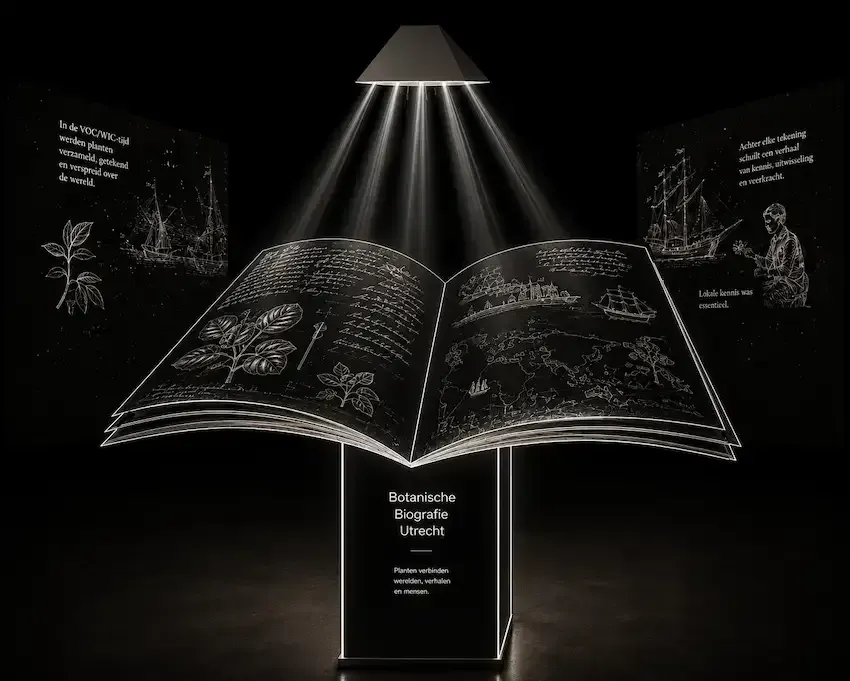
Concept visualization – generated using AI based on the design idea by Marian van Weert
Provincial Botanical Biography
Each Botanical Biography results in a coherent presentation in which historical botanical heritage, contemporary art, and immersive storytelling come together.
At the center stands a monumental sculpture in the form of a large open book, on which the Botanical Biography comes to life through project mapping.
Surrounding this, the contemporary visualizations created by participants under the guidance of a local artist are exhibited.
Where possible, the original historical botanical book or a representation thereof will also be part of the presentation.
After the premiere, the Botanical Biography will tour libraries, botanical gardens, open gardens, provincial government buildings, museums, heritage sites, castles, and country estates.
Botanical Biography of the Netherlands
The twelve provincial Botanical Biographies together form the Botanical Biography of the Netherlands. The ultimate goal is a national overview exhibition in which twelve monumental open books collectively tell the botanical story of the Netherlands. Each province has its own immersive narrative, based on its botanical heritage, history, and identity. Together, the twelve Botanical Biographies show how plants tell the life story of the Netherlands from twelve provincial perspectives.
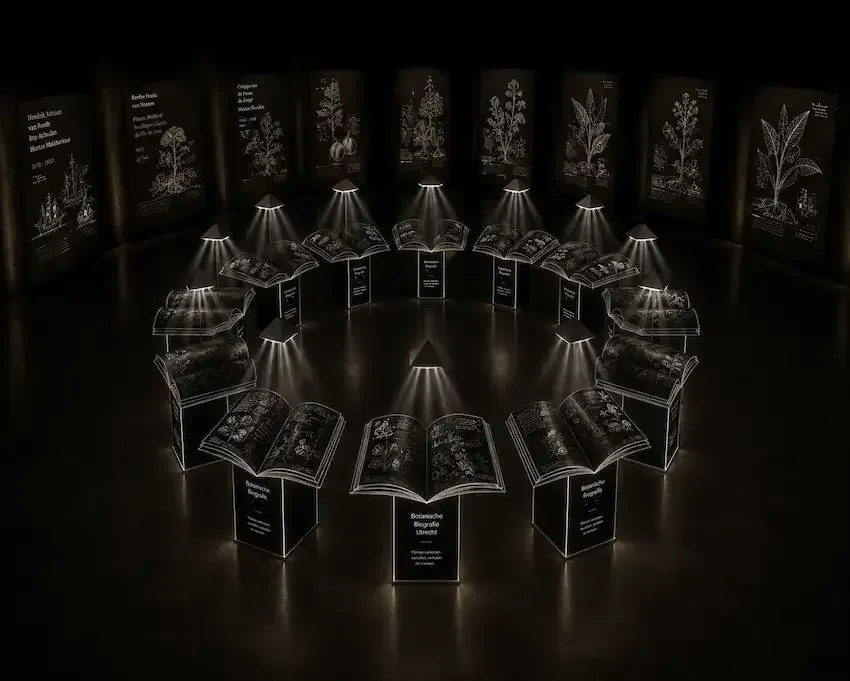
Concept visualization – generated using AI based on the design idea by Marian van Weert
#16. Audiovisual and technical partners
Audiovisual, multimedia, and technical partners are an essential link within the Botanical Biography Method. They translate the historical research, the handmade artworks, and the stories into a high-quality immersive experience in which image, light, projection, sound, animation, and interactive techniques come together.
From concept development onwards, they collaborate intensively with the artistic director, researchers, and artists to make the content accessible to a broad audience in a respectful, innovative, and technically high-quality manner. This multidisciplinary collaboration creates a new form of heritage experience.
The collaboration focuses not only on the realization of the immersive installations, but also on the joint development of new forms of presentation, interactive applications, and innovative ways to make botanical heritage accessible and enjoyable.
#17. Partners/Locations/Platform
Following proven success, libraries, botanical gardens, museums, country estates, and other heritage sites can incorporate one or more monumental book sculptures into their own programming.
The multimedia narratives have a modular structure and can be easily exchanged between locations. As a result, a library, botanical garden, or museum can present not only its own provincial Botanical Biography but also those of other provinces.
They gain access to a collection of twelve provincial stories, allowing the programming to be regularly renewed and enabling visitors to continually discover new Botanical Biographies.
In this way, a national platform is growing step by step, in which botanical heritage becomes visible, tangible, and accessible once again. A platform where locations collaborate, share knowledge, and jointly tell the botanical story of the Netherlands.
We are building a national network in which botanical heritage becomes visible, tangible, and accessible once again.
#18. Public activities
The first priority is developing and realizing a workable provincial Botanical Biography and building the national platform.
In a later phase, locations can develop their own public activities around questions such as:
Which story do you find important to tell?
of:
Which story do you think is still missing?
Each location can answer this question in its own way, tailored to its audience, expertise, and capabilities. This can be done through conversations, lectures, writing activities, workshops, local research projects, or digital applications.
The format need not be prescribed centrally. A library can opt for stories and conversations, a botanical garden for biodiversity activities, and a country estate for research into its own historical ties to plantations and cash crops.
This potential further development allows for local implementation without making the current project too technically or organizationally complex.
#19. Communication
The communication is structured around various mutually reinforcing components. For each province, this general communication plan is supplemented with regional partners, activities, and communication tools.
Click on a tab to read more about a part of the communication.
Website
Botanical Library
Lectures
The Botanical Library is the digital knowledge base of the Botanical Biography. Here, historical books, botanical illustrations, archival sources, research results, and references to collections are brought together. The database connects objects with plants, artists, researchers, locations, themes, and stories, and grows along with every new provincial biography.
Level 5 – Making together
Under the guidance of a local artist, residents work together on a contemporary interpretation of the historical botanical heritage. The original images are re-imagined using contemporary techniques, such as pen drawing, embroidery, papercutting, or other artisanal techniques.
Preferably, people with diverse cultural backgrounds participate, including those with a connection to the country where the original botanical work originated. This creates space for new encounters, conversations, and perspectives.
Goal
Creating a contemporary visualization of the botanical heritage together with residents.
A presentation is developed for each Botanical Biography that can be given at museums, libraries, heritage institutions, educational institutions, and cultural organizations. The lectures introduce visitors to the richness of the botanical heritage in their own province and provide space for questions, additions, and new stories. Where possible, presentations are made available as a digital download via the website.
Youtube
Exhibitions
Immersive book
Where possible, presentations, lectures, interviews, and videos are recorded and published on YouTube. In this way, the stories and research results remain accessible to a broad audience even after the activities have concluded, and can be easily shared and reused by heritage institutions and interested parties.
An exhibition is being developed for each province in which the original botanical heritage, contemporary imagination, artistic research, and immersive installations come together. Visitors are introduced to the historical sources, the stories behind the plants, and the new artworks created during the participatory process.
Active communication takes place around every exhibition via local and regional media, LinkedIn, Instagram, newsletters, and the collaborating heritage, cultural, and nature organizations. In this way, a broad audience is reached, and visitors are invited to discover the botanical heritage of their own province.
The immersive book sculptures form a traveling presentation of the Botanical Biography. Upon request, they can be installed for a fee in libraries, botanical gardens, open gardens, museums, and other heritage institutions. Each installation brings a Botanical Biography to life.
Scrolly Telling
Social Media
Pers & Media
Scrollytelling as a digital narrative form. As the visitor scrolls through the page, the story unfolds step by step with historical images, illustrations, maps, archival documents, minimal animations, audio, and video. This form of storytelling makes complex history accessible, holds attention, and encourages visitors to explore further.
Social media play an important role in building an engaged Botanical Heritage community. Throughout the project, multiple calls will be posted to invite illustrators, artists, researchers, historians, volunteers, and other creatives to contribute to the Botanical Biography.
In addition, historical stories, research findings, special plants, results of drawing days, exhibitions, and new developments are shared at least twice a week. The various platforms are utilized each from their own strengths and reinforce one another.
LinkedIn is used for professional communication. Research results, collaborations, presentations, publications, grant milestones, and new partners are shared here. In this way, a network is built of heritage institutions, museums, libraries, researchers, artists, government bodies, and funds.
Instagram focuses primarily on the visual side of the Botanical Biography. Here, historical botanical illustrations, contemporary interpretations, photos and videos of the creation process, drawing days, exhibitions, immersive installations, and other visual developments are shared. In doing so, a broad audience is inspired and engaged with the beauty, stories, and meaning of the botanical heritage.
Active collaboration with local and national media surrounds every provincial Botanical Biography. New exhibitions, drawing days, and personal stories are shared via press releases, interviews, radio, television, podcasts, trade journals, and online media. By aligning with current societal themes such as biodiversity, cultural heritage, colonial history: slavery, and participation, a broad and diverse audience is reached.
AI & knowledge dissemination
Partners
The Botanical Biography collaborates with libraries, botanical gardens, museums, heritage institutions, and other local partners. They play an important role in reaching a broad audience.
Partners communicate about drawing days, lectures, exhibitions, and other public activities via their own websites, newsletters, social media, event calendars, and press contacts. Through this joint communication, the visibility of the Botanical Biography is significantly increased, and a broad and diverse audience is reached.
In addition, partners contribute to the substantive dissemination of knowledge by actively involving visitors, volunteers, and their own networks in the activities and stories of the Botanical Biography.
#20. Ambition 2032
#1.
The Botanical Biography has reached thousands of visitors and made botanical heritage visible again in libraries,
museums, hortuses, botanical gardens and heritage sites.
#2.
By 2032, the Botanical Biography of the Netherlands will have grown into the leading national platform for botanical heritage. The Botanical Timeline, Botanical Library & Botanical Imagination together form a growing network in which historical research, art, participation, and digital technology are interconnected.
#3.
The contribution of local knowledge holders, indigenous communities, and other often underrepresented voices has been given a natural place within the narrative of botanical science and cultural heritage.
#4.
The Botanical Biography has contributed to a greater historical awareness of the role of plants in the development of the Netherlands. Stories about trade, science, art, colonialism, slavery, contract labor, biodiversity, and landscape are told from the perspective of plants and interconnected.
#5.
The Botanical Biography has grown into an international network in which the Netherlands and the countries of origin work together on research, knowledge sharing, and new perspectives on shared botanical heritage.
#6.
In every province, a Botanical Heritage Community has emerged in which artists, researchers, heritage institutions, volunteers, and residents collaborate on research, participation, and new visualizations of botanical heritage.
#7.
Through the Botanical Biography, the accumulated knowledge has become sustainably accessible to the public, researchers, and heritage institutions.
#21. Target group
The Botanical Biography of the Netherlands targets a broad audience aged approximately 15 to 85. The project brings together people interested in drawing, creating, plants, history, art, heritage, nature, and culture.
Special attention is paid to people with a cultural or family background in countries with which the Dutch botanical heritage is historically connected, such as India, Indonesia, Suriname, Sri Lanka, South Africa, and the Caribbean. Their knowledge, experiences, and perspectives are of great value in enriching the story.
An important target group consists of active residents of a province, including pensioners, who want to use their creativity for a large botanical art project.
By drawing, researching, and sharing stories together, a diverse community emerges in which different generations, backgrounds, and perspectives meet and contribute to a shared Botanical Biography.
At the same time, the Botanical Biography also invites young people, students, and emerging makers to become acquainted with botanical heritage through art and research.
#22. Reach
...........
#20. Organization and collaboration
The Botanical Biography of the Netherlands is being developed under the artistic direction of Marian van Weert, initiator and developer of the Botanical Biography Method. She is responsible for the artistic vision, the content direction, the historical research, the development of the method, and the national coordination of the project.
Foundation io
The Botanical Biography of the Netherlands is being placed under the auspices of an independent foundation.
Management
- Chairperson – vacant
- Treasurer – vacant
- Secretary – vacant
Organization
As the project develops, the organization is gradually expanded with, among other things:
- Communicatiespecialist
- Fundraiser
- Local Project Manager
- Volunteers
- Interns
Following the completion of the first Botanical Biography, the national network will be further expanded with local artists and provincial project leaders, so that each province can be developed from its own regional network, while maintaining national quality and cohesion.
Cooperation
The Botanical Biography is a collaborative project in which artists, heritage institutions, researchers, and residents work together to make botanical heritage visible.
For each province, we collaborate with:
- local artists;
- residents and participants;
- museums, libraries, archives, herbaria, botanical gardens, country houses, estates and historical societies;
- researchers, universities and other knowledge institutions;
- communities with a personal or cultural connection to the countries of origin of the botanical heritage;
The collaboration is structured per province around the selected botanical heritage and the locations substantively connected to the story. This creates a network of partners in which historical research, artistic imagination, participation, and technological innovation reinforce each other.
..............